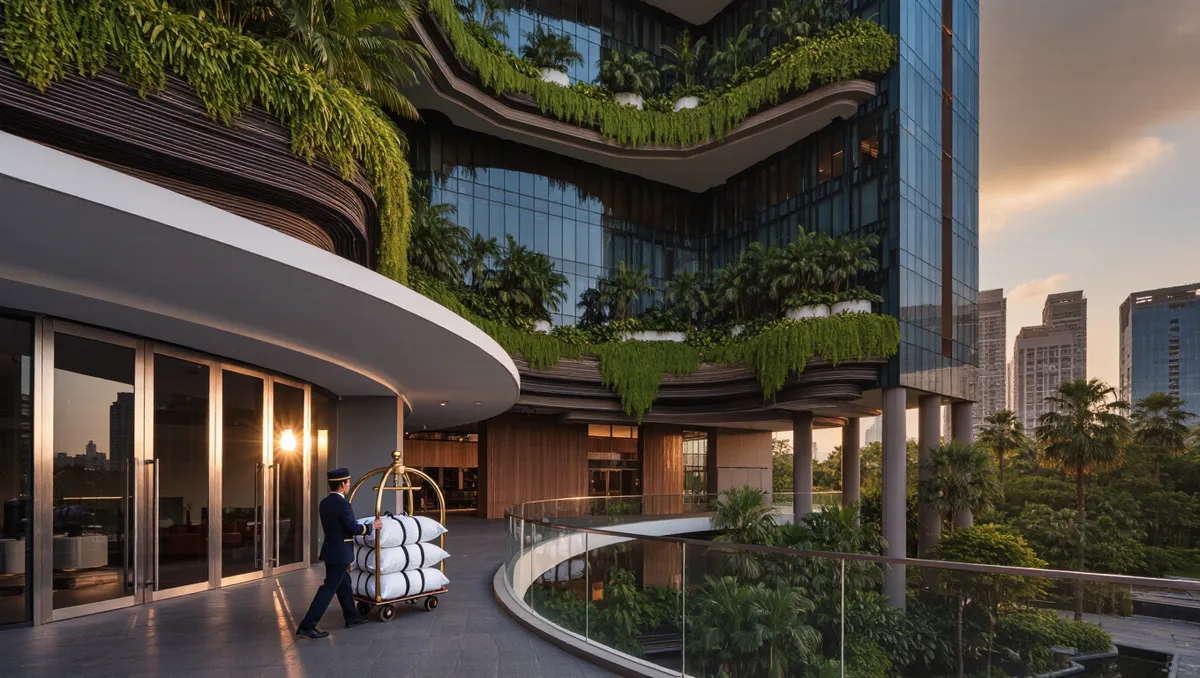
More than half of Pan Pacific Hotels Group's portfolio has been newly built, redesigned or significantly renovated since 2020, according to Breaking Travel News. The Group calls this its Version 2.0 journey, and it now spans properties in Singapore, Kuala Lumpur, Penang, Jakarta, Hanoi, Tokyo, Kyoto, Melbourne, Perth and Sydney.
For operators watching capital cycles, the scale matters. A portfolio overhaul of this share, in under six years, is a bet on how demand is changing rather than a maintenance programme. The Group frames it as a response to shifting traveller behaviour, and the data it cites gives that argument some structure.
Version 2.0 began with Pan Pacific London and PARKROYAL COLLECTION Marina Bay Singapore, per the report. It has since grown into a group-wide transformation covering design, sustainability infrastructure and technology, alongside new developments across the region.
What has actually been rebuilt, and what is coming?
The most visible completed projects set the tone. Pan Pacific London was designed by Yabu Pushelberg with a focus on contemporary luxury, wellbeing and the hotel's connection to its City of London setting. Pan Pacific Orchard in Singapore, open since 2023, has drawn international recognition including the Prix Versailles and honours from the Council on Tall Buildings and Urban Habitat.
The next wave is concentrated in Southeast Asia. In 2027, ten new-build and major renovation projects are scheduled, extending the Group's reach across luxury, upscale and serviced suites. The named projects include Pan Pacific Phnom Penh, PARKROYAL Siem Reap, Siam Pan Pacific Bangkok, Pan Pacific Serviced Suites Thonglor in Bangkok, PARKROYAL Hanoi, PARKROYAL Serviced Suites Manila Bay and PARKROYAL Jakarta, plus transformations of PARKROYAL Serviced Suites Kuala Lumpur, PARKROYAL Gurney Bay Penang and PARKROYAL COLLECTION Pickering in Singapore. Readers following this should also see The hotel ramp-up curve: how new properties reach stabilized performance. Readers following this should also see The hotel ramp-up curve: how new properties reach stabilized performance.
For operators, the sequencing is the signal. The 2027 slate mixes new-build projects with transformations of existing serviced-suites properties, such as PARKROYAL Serviced Suites Kuala Lumpur, alongside entries in markets including Phnom Penh, Siem Reap, Hanoi, Manila Bay and Jakarta.
Why is the Group repositioning now?
PPHG's stated reasoning rests on demographic and behavioural shifts. According to Breaking Travel News, Gen Z and Millennials are projected to make up 74% of the global workforce by 2030. Deloitte's 2025 research, covering nearly 23,000 people across 44 countries, found these generations increasingly define success through a mix of money, meaning and wellbeing. Around nine in ten say purpose matters to their job satisfaction and wellbeing. We covered a connected angle in Booking.com fraud warnings make verification the traveler's job: what to check before arrival. We covered a connected angle in Booking.com fraud warnings make verification the traveler's job: what to check before arrival.
The Group's chief executive, Choe Peng Sum, put the brand logic plainly: "We do not want one brand to be everything to everyone." His stated ambition is a portfolio where each brand has a clear reason to exist while the Group captures different forms of demand.
Choe framed the broader case in a second quote: "The market has moved, and we have to move with it." He argued that the boundaries between work and leisure, business and personal time are increasingly fluid, and that "we cannot respond to that with yesterday's hotel model."
What does the demand data actually show?
Several data points in the report sketch the demand picture the investment is aimed at.
- Blended travel is mainstream in Asia Pacific. Agoda's survey found 76% of business travellers in the region plan to combine business with leisure, rising to 92% in Thailand and 86% in Vietnam.
- Affluent travellers are spending more, and tying it to wellness. 72% of affluent APAC travellers surveyed expect to increase their luxury-travel spending, while 90% say wellness influences their booking decisions, up from 80% a year earlier.
- Sustainability has moved into booking behaviour. Booking.com's survey found 93% of global travellers want to make more sustainable travel choices, and 58% say they are already changing their travel behaviour to do so.
- Technology is reshaping the service floor. An Oracle Hospitality and Skift study of more than 5,000 consumers and 600 hotel executives found 53.6% of travellers want contactless check-in and check-out to remain permanent, and 39.3% want mobile guest services.
The Oracle study's underlying finding is the one most useful for operators: travellers do not want less hospitality. They want technology to remove routine friction so staff can spend more time on personalised service. That is the same framing PPHG uses for its own technology investments.
What does Version 2.0 mean for how the hotels run?
PPHG describes Version 2.0 as a comprehensive transformation rather than a renovation programme or a single design language. It covers the physical product, brand proposition, guest experience, sustainability and technology, supported by stronger operating capabilities. The stated objective is not uniformity but distinctiveness: each brand made more relevant to the market it serves.
Operationally, three threads run through the description. Design leans biophilic and wellbeing-led, with internationally recognised architects and designers attached. Environmental infrastructure is upgraded across the portfolio, which aligns with the Booking.com data on traveller expectations. And technology is deployed to strip friction out of arrivals and in-stay services, explicitly to free staff time for hospitality.
For operators considering similar repositioning, the model on display is a portfolio-level thesis about demand, executed property by property, rather than a one-off flag upgrade.
Where does the growth concentrate?
Southeast Asia carries the expansion. Bangkok recorded 30.3 million international arrivals in 2025, making it the world's most visited city by international arrivals, according to the report. Placing Siam Pan Pacific Bangkok and Pan Pacific Serviced Suites Thonglor there puts the Group's luxury and serviced-suite brands in that demand pool at the same time.
The wider 2027 slate, from Phnom Penh and Siem Reap to Hanoi, Manila Bay and Jakarta, extends the same regional focus. The evidence in the report establishes the project list and the demand data behind it; what it does not yet establish is how the new properties will perform once open. That remains the open question for anyone tracking the programme's return.