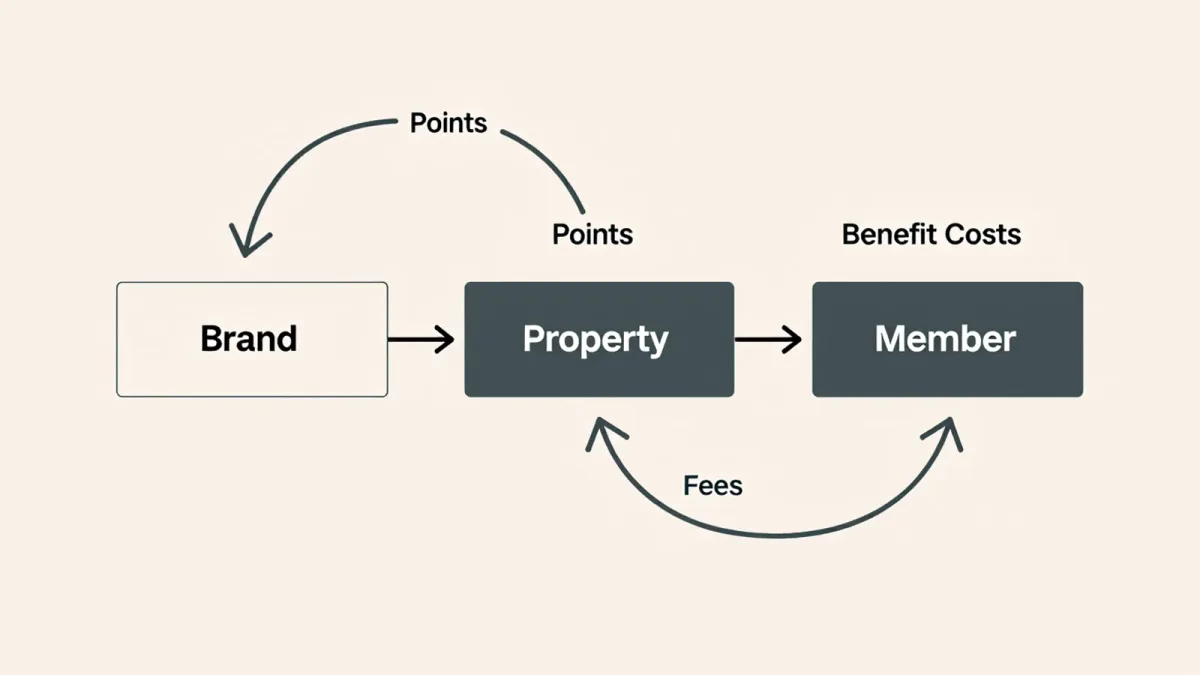
Major hotel loyalty programs are among the largest membership systems in consumer business — Marriott has stated Bonvoy membership exceeded 228 million members as of 2024, and Hilton has stated Honors membership above 200 million; both figures are company statements about their own programs. What the headline counts obscure is the operator's side of the ledger: the property that hosts the points-earning stay carries real costs for a guest relationship the brand owns.
Understanding that ledger is the difference between loyalty as a benefit and loyalty as a hidden fee.
Who actually funds the points?
Four sources fund program liabilities: breakage — points that expire or lapse unredeemed; the sale of points to credit card and travel partners, which for large programs is a revenue stream in itself; per-stay program contributions embedded in franchise and management agreements; and the in-kind value of benefits the property delivers at its own cost — elite upgrades, lounge staffing, breakfast, late checkout.
The last category is the operator's quiet exposure. A suite upgrade given for points-earned status consumes sellable inventory; a lounge requires staffed square meters; breakfast for elites is covers at marginal cost. These are real costs booked in food cost and lost revenue, not in a program line.
What does the operator get back?
The return comes through occupancy support and guest quality. Members book more nights, book more directly through brand channels, and are more price-tolerant than transient walk-in demand — program channels deliver base occupancy that lets revenue management push the remaining inventory to market rates. In franchise economics, the program is also part of what the royalty buys: the flag on the door is substantially the database.
The tension is recognition economics. When elite benefits concentrate — a property with heavy elite mix during peak dates — the operator is delivering the program's promise out of sellable inventory at the worst possible moments. Well-run franchise agreements cap or compensate certain benefit costs; poorly reviewed agreements leave the property absorbing them.
What should an operator check in their own books?
- Effective program cost per occupied room: program fees plus benefit costs at actual delivery rates.
- Elite mix by day of week, so benefit costs are visible against the dates they land.
- Upgrade delivery: how many suites are given to status rather than sold, and at what foregone rate.
- Channel contribution: revenue per booking from program channels versus OTA and transient direct, on equal dates.
- Contract language on benefit caps, compensation and audit rights in the franchise or management agreement.
Can an operator opt out?
Within a major brand, no — program participation is a condition of the flag, and the flag is the asset the franchise fee monetizes. The operator's leverage is at signing and renewal: benefit scope, cost caps and data access are negotiable; the program itself is not. For independents, the strategic question is reversed — whether building a modest owned program beats paying commissions for someone else's members, a decision that sizes itself against the property's repeat-guest share.
Loyalty is not free occupancy. It is a funded system whose costs land partly on the property ledger — and operators who measure the landing get to negotiate accordingly.