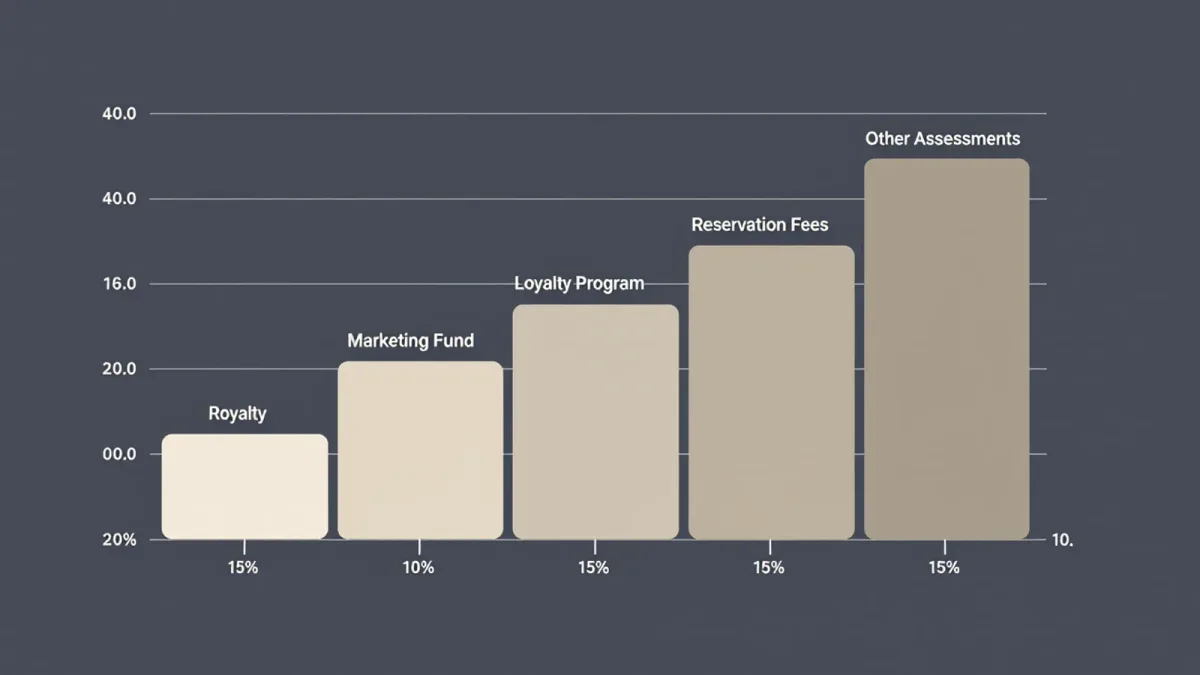
Franchise fees are the recurring payments a hotel owner makes to use a brand: the royalty on rooms revenue, contributions to marketing and loyalty programs, reservation-system charges and various assessments. Add the components up and the total commonly lands in the range of 10-15% of rooms revenue for major US chains — a range reflected in franchise disclosure documents and industry fee surveys, though every agreement is its own contract.
For owners, the stack is the price of the flag: distribution, demand and the standards apparatus behind it. Knowing what each component buys is how the price gets negotiated.
What are the components of the fee stack?
The recurring lines in a typical franchised hotel agreement:
- Royalty fee — the core charge, commonly in the 4-6% of gross rooms revenue range per published franchise disclosure documents, though program tier and brand move it.
- Marketing and program fees — contributions to brand advertising funds, commonly 2-4% of rooms revenue.
- Loyalty program charges — per-stay contributions funding the points system; in some agreements assessed on program revenue.
- Reservation and system fees — charges tied to bookings delivered through brand channels, sometimes quoted per reservation or as a percentage of booked revenue.
- Other assessments — technology fees, training, quality-inspection and reimbursement items that accumulate; industry fee surveys have noted the proliferation of these smaller lines.
The regime is contractual: in the United States, franchising operates under the FTC Franchise Rule, which requires franchisors to deliver a franchise disclosure document setting out fees before sale — making the document itself the operator's first reconciliation tool.
What does the stack buy?
The honest answer is distribution and demand. A brand flag brings the loyalty database, central reservation systems, negotiated corporate and group demand, a consumer marketing engine no single property could fund, and standards and inspection that hold the product to the promise. For properties without their own demand generation, that is frequently worth the double-digit percentage — the comparison is not against zero but against the alternative cost of filling the same rooms.
For operators, the audit question is attribution: how much booked revenue actually arrived through brand channels versus through channels the property would have had anyway. Agreements vary in what they charge for; the reconciliation belongs in the operator's monthly close, not at renewal.
Where do owners push back?
At signing and renewal, on defined terms: the royalty rate and its revenue definition; caps or fee holidays during ramp-up; incentive tiers that reduce fees against performance; clarity on which assessments are reimbursables versus revenue; and term and exit provisions, since termination schedules define how expensive it is to leave a brand. Franchisors, for their part, negotiate on brand integrity — property improvement programs and standards enforcement are the quid pro quo.
The fee stack is not a mystery; it is a menu of definitions. Owners who read the definitions as closely as the rates are the ones who know what the flag actually costs.