Sustainability means being able to keep doing something over a long period without running out of what makes it possible. In practice, it usually means running a business so the environment, the economy, and the community around it all keep working — not just for this year's budget, but for the next decade. That is the plain version. The rest of this article unpacks it, because the word gets used loosely enough that a reader can be forgiven for wondering whether it means anything at all.
The most quoted formal definition comes from the United Nations. The 1987 Brundtland Report, Our Common Future, defined sustainable development as development that "meets the needs of the present without compromising the ability of future generations to meet their own needs." Wikipedia's overview of sustainability notes that this report helped push the concept into mainstream policy discussion, and that the terms "sustainability" and "sustainable development" are often used interchangeably — the first as a long-term goal, the second as the processes that get there.
For hotel operators, the definition matters less as philosophy and more as a filter. A property that cuts water use, keeps staff long-term, and still turns a profit is practicing it. A property that prints a green logo on its website without changing anything measurable is not. Knowing the difference starts with knowing what the word covers.
What are the three dimensions, and why do they matter together?
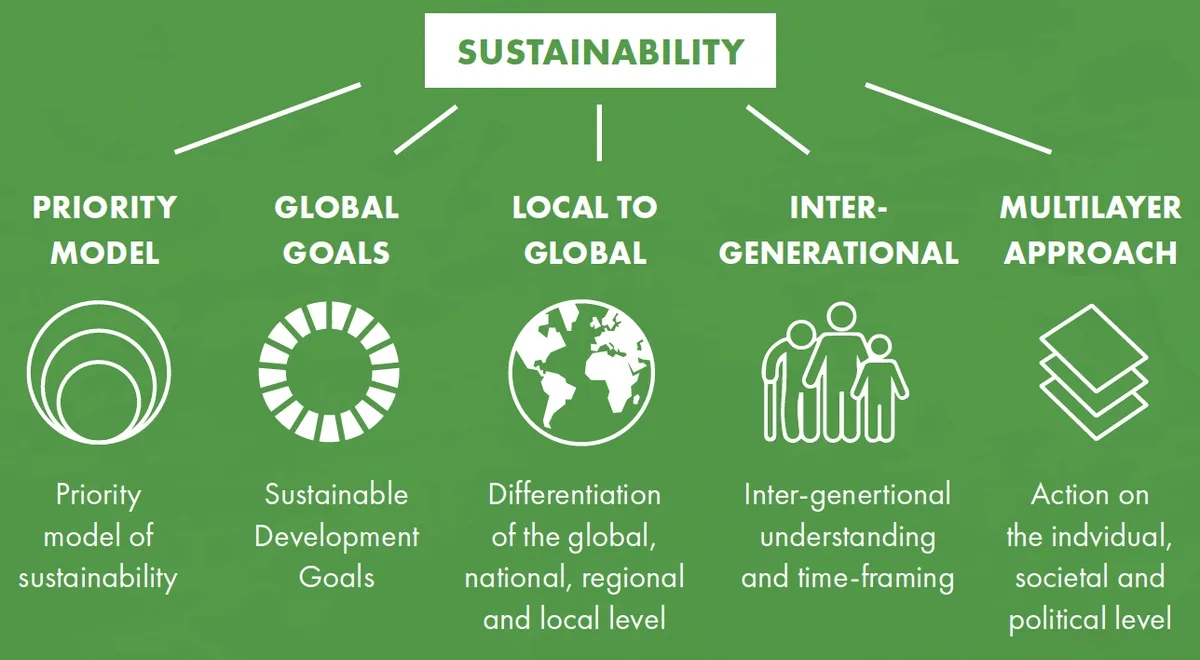
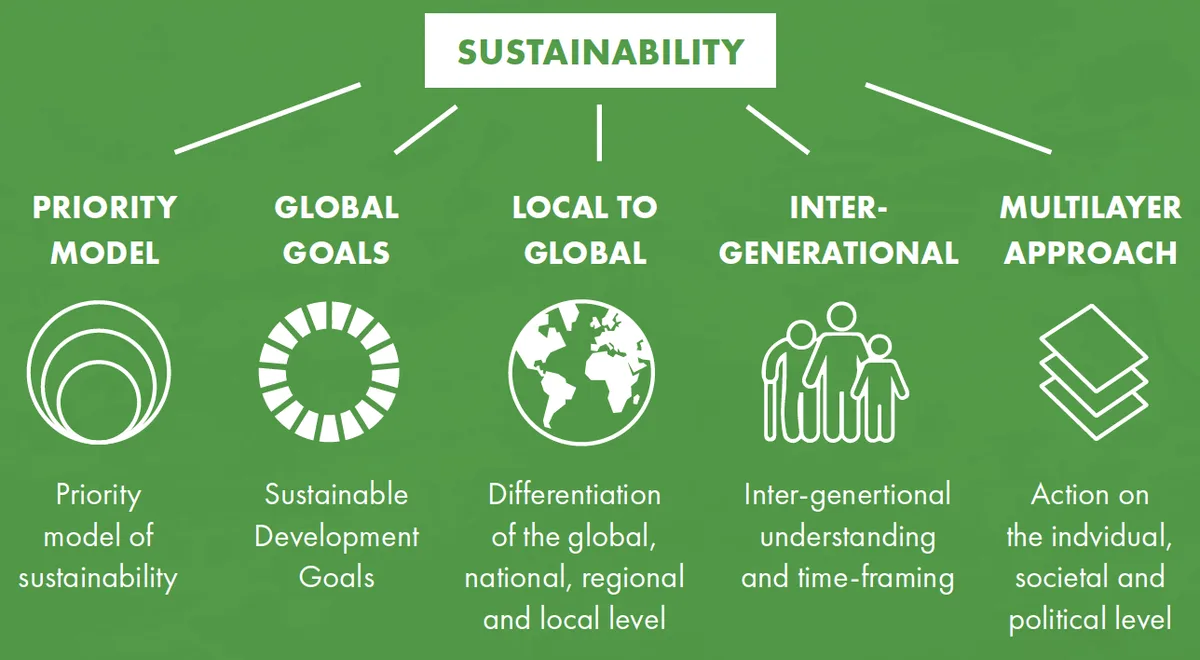
Sustainability is usually described as having three parts: environmental, economic, and social. UCLA's sustainability program defines it as "the balance between the environment, equity, and economy," and its own committee charter calls it "the integration of environmental health, social equity and economic vitality." The point of the three-part framing is that none of the parts survives alone. A hotel that protects the environment by cutting jobs has traded one problem for another. A hotel that protects profits by ignoring water and energy use is borrowing from a future bill.
The dimensions are often drawn as three overlapping circles, or as nested rings where the economy and society sit inside the environment. The drawing matters less than the logic: a change in one dimension eventually shows up in the others. For an operator, that means a sustainability decision is never only an energy decision or only a labor decision. It is both at once.
There is real disagreement inside the field about how the economic dimension fits. Scholars debate what is called weak versus strong sustainability — roughly, whether economic gains can substitute for environmental losses or whether some natural resources are irreplaceable. Wikipedia's entry records this tension directly: there is "always tension between the ideas of 'welfare and prosperity for all' and environmental conservation, so trade-offs are necessary." An operator does not need to resolve that debate. An operator needs to know the trade-offs exist and price them honestly.
Where did the word come from?
The modern usage traces to the United Nations. The 1983 UN Commission on Environment and Development — better known as the Brundtland Commission — produced the 1987 report that supplied the definition still quoted today. According to Wikipedia's account of the term's history, the report "helped bring sustainability into the mainstream of policy discussions" and popularized sustainable development as a concept.
The underlying principle is older and simpler. As the US Environmental Protection Agency puts it, sustainability "is based on a simple principle: Everything that we need for our survival and well-being depends, either directly or indirectly, on our natural environment." Strip away the conference vocabulary and that is the whole idea: the resource base is not optional, so it cannot be treated as free.
One caution from the record: the concept is contested. Some critics call it vague or a buzzword. Others question whether it is achievable at all — Wikipedia cites experts who note that "no country is delivering what its citizens need without transgressing the biophysical planetary boundaries." The criticism is fair, and it is also the reason precision matters. A word that means everything means nothing, which is exactly the opening greenwashing exploits.
How do you tell real practice from a buzzword?
The test is measurement. A sustainability claim that cannot be checked against a meter, an invoice, or a staffing record is a slogan. UCLA's charter acknowledges the point from the academic side, noting that the practice "requires a systems approach and an acknowledgement of complexity." In a hotel, the systems approach looks concrete: sub-metered water lines, energy bills read against occupancy, waste weighed rather than estimated, and turnover tracked alongside any new program. For related coverage, see Food donation programs: the hotel food-waste outlet most properties never set up.
The field has built tools for this. Wikipedia's entry lists the measurement apparatus that has grown up around the concept: indicators, benchmarks, audits, certification systems such as Fairtrade and Organic, and accounting frameworks including corporate sustainability reporting and triple bottom line accounting. None of these is proof by itself. Each is a structure that makes a claim checkable — which is the minimum standard a claim must meet to be more than decoration.
What this means for an operator evaluating a vendor, a certification, or a corporate mandate: ask what number moves, over what period, measured how. A linen reuse program that reports gallons saved per occupied room is practice. A brochure that says "committed to the planet" is not. The same discipline applies in-house — a property that cannot state its own baseline cannot claim improvement against it.
What does the definition actually ask of a hotel?
Read the Brundtland definition again with a property in mind: meet today's needs without compromising tomorrow's. Translated into hotel operations, that yields a short list of questions.
- Resources: Does the property know its water and energy use per occupied room, and is that number trending down?
- Waste: Is food and material waste measured, and is there a working outlet — donation, diversion, or reduction — rather than a bin?
- People: Are staffing levels and pay stable enough that the operation does not depend on burning out workers? The social dimension is not separate from the environmental one; both show up in the same P&L.
- Economics: Do the programs pay for themselves over a defensible horizon, or do they survive only as marketing?
A property that can answer those four questions with numbers is practicing sustainability, whatever it calls the program. A property that cannot is performing it. The distinction is the whole game, and it is why the jargon-free definition is worth defending.
Our analysis: why the plain definition beats the polished one
The industry's relationship with this word is strained precisely because it is a "normative concept" — in Wikipedia's phrasing, it is "based on what people value or find desirable." Values language invites performance. Numbers resist it. That is why the most useful definition for a hotel operator is not the most eloquent one but the most falsifiable one: sustainability is the ability to continue, demonstrated by measurements that would embarrass you if they moved the wrong way.
The trade-offs are real and should be named. UCLA notes that sustainability "presumes that resources are finite, and should be used conservatively and wisely with a view to long-term priorities." Finite resources mean every operational choice allocates something — water, energy, labor hours, capital. A program that hides its costs is not sustainable in the economic dimension, no matter how good its environmental story reads.
The honest position, then, is neither cynicism nor enthusiasm. The concept has a documented lineage, a three-part structure, and a growing measurement apparatus. It also has documented criticism and no fixed definition of its indicators. An operator who holds both facts at once will spend sustainability budgets on meters and programs rather than logos — and will be able to prove, to a owner, a lender, or a regulator, that the word on the website means something.
Where the definition meets the balance sheet
Sustainability, defined without the jargon, is a capacity question: can this operation continue? The Brundtland definition supplies the time horizon — future generations. The three-dimension framework supplies the scope — environment, economy, society. The measurement tools supply the evidence. Everything else, every adjective and badge, is either supported by those three things or is noise. The paperwork, as ever, is the difference.