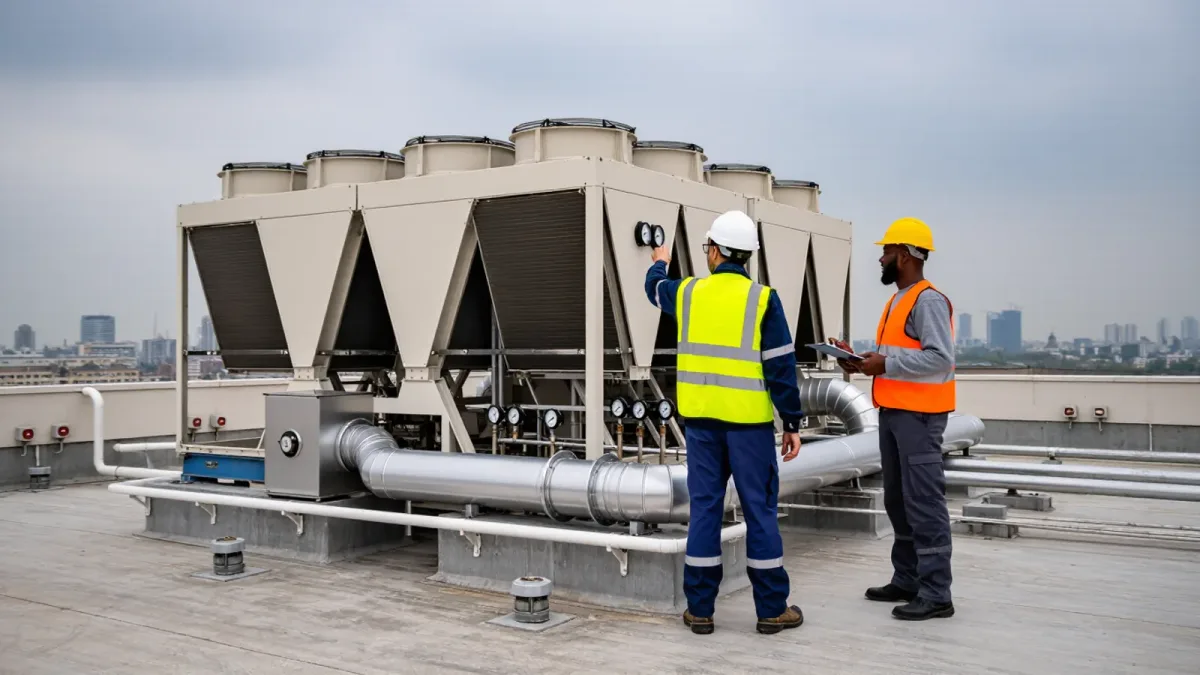
HVAC retrofits are where hotel energy budgets are won or lost. Space heating and cooling together account for roughly 40 percent of energy use in a typical US commercial building, per the US Energy Information Administration's Commercial Buildings Energy Consumption Survey, and hotels run that load around the clock because guestrooms must be conditioned whether or not they are occupied. For operators, that makes the HVAC plant the first place to look when a sustainability target or a utility bill demands action.
Why do hotel buildings waste HVAC energy in the first place?
Three structural reasons. First, hotels condition far more volume than they occupy: a 200-room property running full-service conditioning without setbacks conditions empty rooms for most of the day. Second, systems are sized and zoned for design peaks that occur a few days a year, so equipment spends most of its life inefficiently far below load. Third, incremental renovations — a new VAV box here, a guestroom thermostat there — leave the central plant operating against a distribution system it was never re-balanced for.
The result is a building that can look modern in the guestroom while its chiller, boilers, and air handlers run on a control logic written a decade earlier.
What does the low-cost end of the retrofit ladder save?
Operators rarely need to start with a chiller replacement. The standard sequence runs from controls to distribution to plant:
- Guestroom energy management systems (GMEM). Occupancy-linked setbacks on guestroom conditioning routinely cut guestroom HVAC energy by double-digit percentages, because empty rooms drift to a wider deadband. Vendor claims vary; the mechanism — conditioning only occupied volume — is not in dispute.
- Scheduling and setpoint discipline in back-of-house. Corridors, ballrooms, and kitchens conditioned on 24/7 schedules that no one has audited are a recurring finding in energy audits.
- Heat recovery. Hotels are unusual among commercial buildings in that they simultaneously heat (domestic hot water, winter preheat) and reject heat (condenser loops). Recovery plates between those streams convert a waste stream into a load offset.
- Distribution fixes — variable-speed pumping, valve and damper repair, balancing — before touching the central plant itself.
Only after that ladder is climbed does equipment replacement enter: high-efficiency chillers, condensing boilers, or heat-pump plants, each with capital costs measured in hundreds of thousands of dollars for a full-service property.
How do heat pumps change the calculation?
Electrification rules now push the same direction as efficiency. In jurisdictions restricting fossil-fuel equipment in new construction and major renovations, end-of-life boiler replacement increasingly means heat pumps — air-source for milder climates, water-source or variable-refrigerant-flow where space allows. The economics hinge on the spark spread between gas and electricity in the local market and on whether the electrical service can carry the new load without an upgrade. Operators evaluating a plant change should price the utility service upgrade in the same envelope as the equipment, because in older urban buildings it can rival the mechanical cost.
What does a retrofit actually cost, and when does it pay back?
Published case studies from utility programs and the US Department of Energy's Better Buildings initiative consistently show controls-level measures paying back in one to three years and plant replacements in the 7-to-15-year range, with the spread driven by local utility rates and run hours. Two disciplines keep those numbers honest. Insist on measurement and verification against a documented baseline rather than vendor projections, and sequence the work so that cheap measures shrink the load before equipment is sized against it — a chiller sized for a building that has since received GMEM and distribution fixes will be a smaller, cheaper chiller.
How does this connect to carbon compliance?
As of 2025, building-performance rules in several US and European jurisdictions convert avoided energy directly into avoided fines. New York City's Local Law 97, whose first compliance reports were due May 1, 2025, prices emissions above a building's cap at $268 per metric ton of CO2-equivalent — a line item that now belongs in every retrofit business case for covered New York properties. Similar caps are spreading to other large cities, which means HVAC capital planning is no longer purely a utility-spend exercise; it is also a compliance-cost exercise.
For operators, the sequence is the savings: controls first, distribution second, plant last — sized after the load has actually fallen.
The properties that report the strongest retrofit results share one habit: they treat the HVAC system as a portfolio of measures with different paybacks rather than a single capital event. That framing also makes financing easier, because early low-cost wins generate documented savings that support the larger loan for the plant replacement — and give the sustainability report a number the finance team will sign.