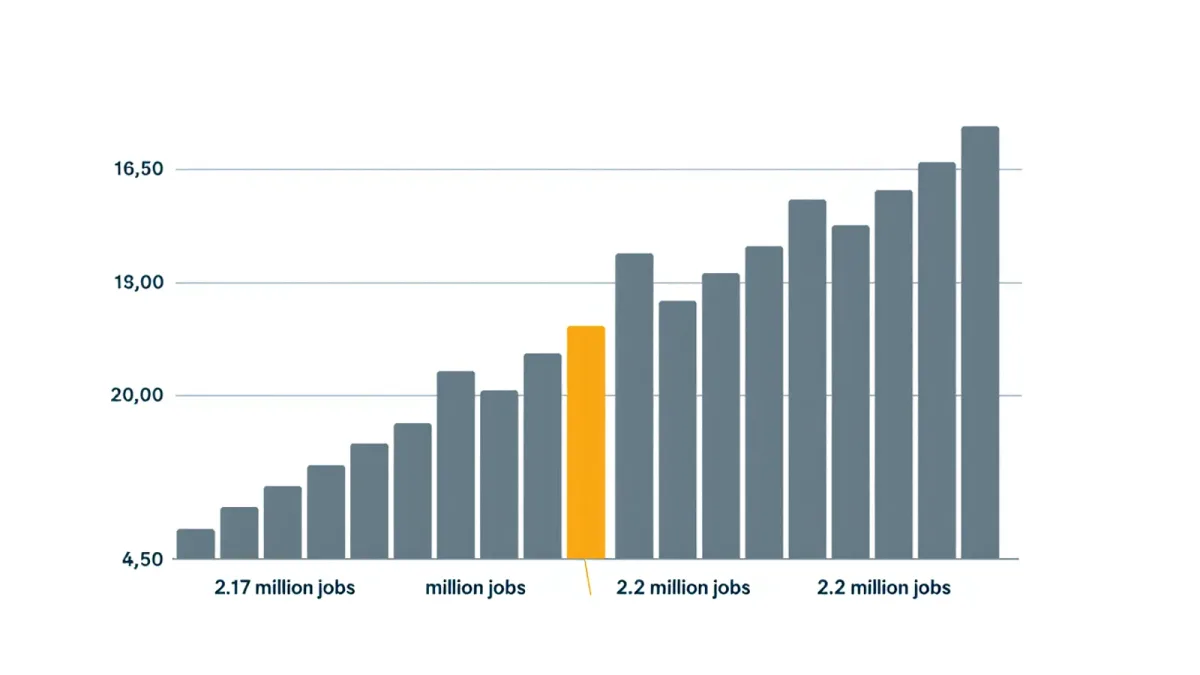
US hotels are projected to add more than 30,000 jobs in 2026, lifting direct hotel operations employment to roughly 2.2 million, per the American Hotel & Lodging Association's 2026 State of the Industry report. Yet over half of surveyed respondents said their properties remain somewhat or severely understaffed.
For operators, the pairing is the story: the industry plans to hire into a labor market that has not loosened enough to make hiring easy, and wage and benefit costs keep climbing alongside insurance, utilities, and other operating expenses the report flags as rising.
What the report says
AHLA's annual report aggregates economic-impact and workforce data across the US lodging industry. The 2026 edition describes an industry that has largely rebuilt employment from pandemic lows but still cannot fill every housekeeping, front office, and F&B seat — the reason more than half of surveyed properties classify themselves as understaffed. The full report is published at ahla.com/soti, with companion state-by-state economic impact reports.
What it means for property-level staffing
The projection of 30,000 new jobs works out to a modest expansion — roughly 1.5% on a 2.2 million base — which aligns with how many operators have restructured since 2020: leaner core schedules, cross-trained roles, and technology absorbing routine front-desk and back-office tasks. For a 150-room select-service property, the practical takeaway is that competitors will be recruiting from the same shallow pool, so retention economics — scheduling stability, wage progression, benefits — compete directly with acquisition spending on recruitment.
Understaffing at scale also shows up in guest-experience metrics: housekeeping frequency choices, food-and-beverage hours, and check-in wait times are all labor-dependent. Operators planning 2026 service standards against an understaffed baseline should price that into posted services rather than absorbing silent service cuts.
Costs are the second squeeze
AHLA's read on 2026 emphasizes rising costs as the industry's other headwind. With revenue growth expected to stay modest — STR/CoStar data showed RevPAR declining in 2025 — margin pressure lands squarely on the operating statement's cost lines. Labor is the largest controllable one.
The report is a planning document, not a market forecast: it represents an association's aggregation of member surveys and economic modeling. But its two headline facts — 2.2 million direct jobs, and half of properties short-staffed — set the staffing agenda most management companies will work from this year.