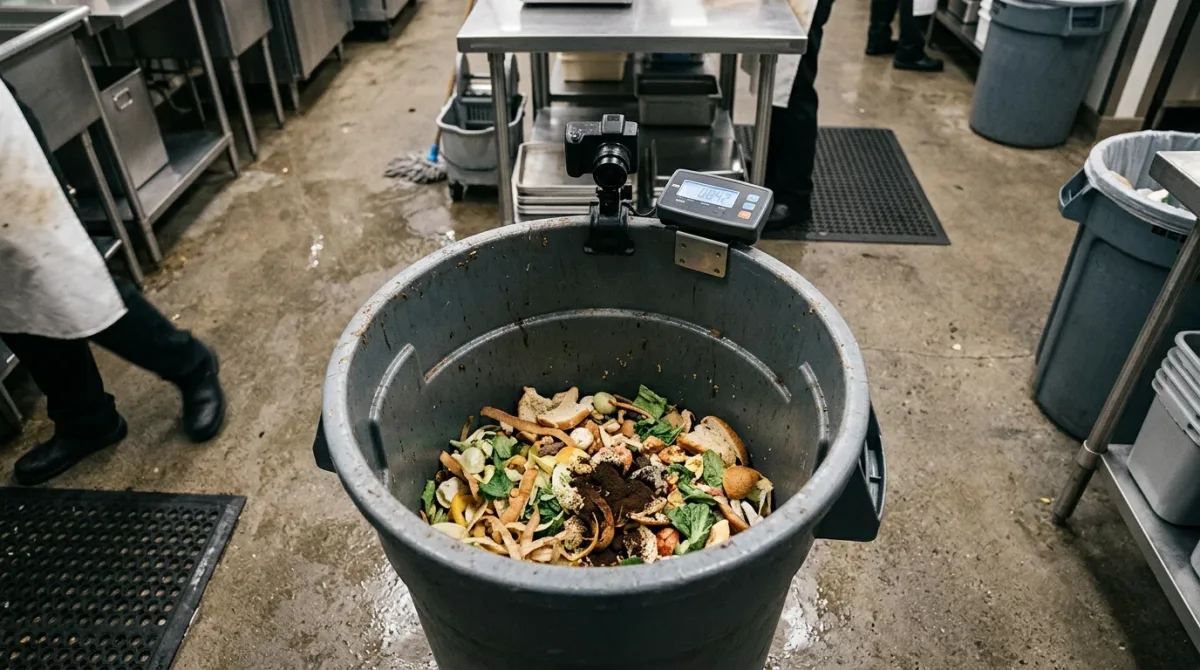
AI food waste tracking is kitchen technology that pairs a camera with a smart scale mounted above the waste bin, identifying and costing every item of food a cook throws away. For hotel food-and-beverage teams, it turns an expense that used to surface only at month-end — overproduction, trim, plate returns — into an itemized daily report tied to a dollar figure.
The best-documented version of this technology in hotels is Winnow Vision, built by London-based Winnow, which launched the AI-powered system in 2019 after founding the company in 2013 to attack commercial kitchen waste.
How does the system work in a hotel kitchen?
A wall-mounted camera photographs each item dropped into a bin sitting on a connected scale. Machine-learning software, trained on a large library of kitchen images, identifies the food and calculates its weight and cost, then sends a report to the chef and F&B director each morning, according to Winnow's own description of the product.
That is a shift from the older method most kitchens still use: a paper waste log filled in by hand, usually inconsistently, with no automatic cost attached. The AI system removes the manual step and, because it logs every discard, gives a chef a running tally of which dishes are overproduced and which prep cuts are running heavy — the kind of granular detail a monthly P&L line for “food cost” cannot show.
What savings does the vendor claim, and what has independent reporting confirmed?
Winnow states that hotels using its system typically cut kitchen food waste by 40% to 70% and reduce total food costs by 2% to 8%, and lists Hilton, Marriott, Accor, IHG, Mandarin Oriental, Iberostar and Four Seasons among hotel groups that have deployed it — claims made by the vendor about its own product, not independently audited.
Trade coverage has put numbers to specific properties. Hotel Dive reported that Hilton Dubai Jumeirah and Marriott's Grosvenor House in Dubai each cut kitchen waste by roughly 70% after installing the system. Iberostar Hotels & Resorts, which rolled the technology out across 20 properties, told Hotel Dive it saved 533,000 meals and 213 tons of food, reduced per-stay waste sent to landfill by 35.61%, and projected the program would save the company $7 million a year.
| Property or group | Reported result | Source |
|---|---|---|
| Hilton Dubai Jumeirah | ~70% reduction in kitchen food waste | Hotel Dive |
| Marriott's Grosvenor House, Dubai | ~70% reduction in kitchen food waste | Hotel Dive |
| Iberostar Hotels & Resorts (20 properties) | 35.61% cut in per-stay waste to landfill; 533,000 meals and 213 tons of food saved; projected $7M in annual savings | Hotel Dive |
“It’s a great tool for us to be able to ensure that we’re being as efficient as possible in the production of foods,” Megan Morikawa, Iberostar’s global director of sustainability, told Hotel Dive.
What does the system cost to run, and how fast does it pay back?
Winnow says its customers save $7 for every $1 spent on the system and that 95% of properties recover their investment within two years — figures the company reports for its own installed base, which it puts at more than 3,500 kitchens across 94 countries, with combined customer savings exceeding $100 million a year. None of that is broken out per property or verified by a third party in the material available, so an operator evaluating the pitch should treat it as a vendor claim to test against a property's own baseline food cost, not a guaranteed return.
What should an operator ask before signing on?
The published case studies are the vendor's best examples, not a representative sample, and neither Winnow nor the hotel groups it names have released third-party audits of the savings figures. An operator comparing bids should ask a supplier for waste and cost data broken out by property, not a blended average, and should ask how a baseline is set — savings look larger when measured against a kitchen's worst month than its typical one.
It is also worth separating two different numbers: the waste-reduction percentage, which measures pounds or kilograms kept out of the bin, and the food-cost percentage, which is what shows up on the P&L. Winnow's own figures put the first in the 40% to 70% range and the second at 2% to 8%, and the gap between them is the part of overproduction that would have been eaten, comped, or repurposed anyway rather than converted straight to cash.
Why the waste is worth tracking in the first place
Food service is not a marginal contributor to the waste problem the technology targets. The United Nations Environment Programme's Food Waste Index Report, published with WRAP in 2021, found that 931 million tonnes of food were wasted at the consumer level globally in 2019 — 17% of all food available to consumers — with food services accounting for 5 percentage points of that total, against 11 points from households and 2 from retail. Kitchen-level waste in hotels and restaurants is a measurable slice of a problem large enough that UNEP frames it as a climate issue as much as a cost one.
That context matters for how an operator should read Winnow's installed-base numbers. The company says its system is now running in more than 3,500 kitchens across 94 countries, drawing on a training set the company describes as more than 500 million images, which is a meaningful footprint inside a sector-wide waste problem measured in the hundreds of millions of tonnes — but still a small fraction of the world's commercial kitchens, most of which have no automated tracking at all.
For operators, the case for tracking waste does not depend on believing every vendor figure. It depends on whether a kitchen currently knows, dish by dish, what it throws away — and most still do not. A paper log tells a chef that waste happened; a camera and a scale tell a chef which dish, on which night, and what it cost. That distinction is what the vendor's pitch and the property-level reporting agree on, even where the headline percentages should be read with the source attached.
For a related design perspective, read Office-to-hotel conversion: what the cost data actually shows.