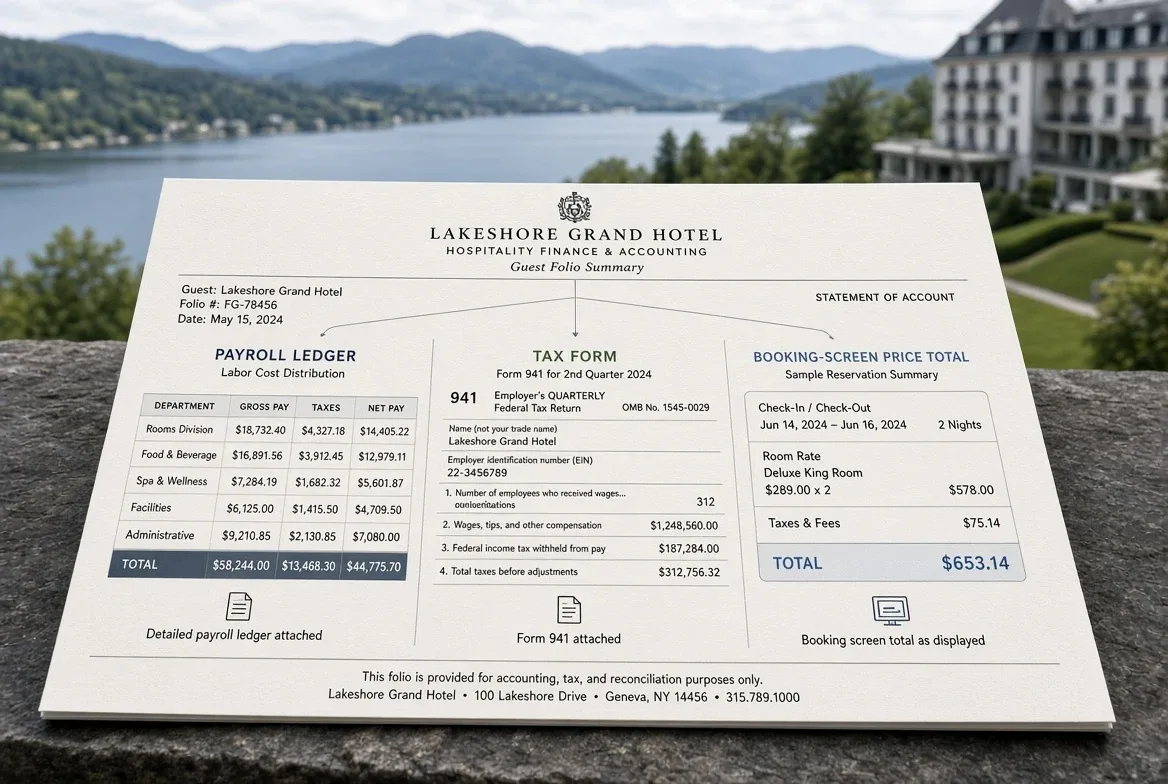
A service charge is a mandatory amount a hotel adds to a guest's bill — a resort fee, a banquet fee, an automatic gratuity on a large party — and under federal rules it is not a tip. The distinction decides payroll treatment, whether the money can offset wage obligations, and, since May 2025, how the charge must appear in the advertised price.
Three separate federal regimes touch the same line item: wage and hour rules at the Department of Labor, tax reporting at the IRS, and price disclosure at the Federal Trade Commission. Each uses its own test, and a charge structured for one can create exposure under another.
What separates a tip from a service charge?
Discretion. IRS Fact Sheet 2015-8 sets out four factors that must all be present for a payment to be a tip: the payment is made free from compulsion; the customer has the unrestricted right to determine the amount; the payment is not the subject of negotiation or dictated by employer policy; and generally the customer decides who receives it.
Fail any of them and the money is a service charge. The IRS fact sheet lists a hotel room service charge, a banquet event fee and an automatic gratuity on a large dining party as examples, and states that service charges are reported as non-tip wages paid to the employee, withheld and reported like any other wages under Publication 15.
The wage rules land in the same place by a different route. 29 CFR 531.55 states that a compulsory charge for service, such as 15 percent of the amount of the bill, imposed on a customer by an employer's establishment, is not a tip. The regulation adds that such sums, when distributed to employees, may be counted in full toward the Act's monetary wage requirements — but not through the tip credit.
How do the two categories differ in practice?
The table below compares the treatment of each category under the federal rules cited in this article. It is a summary of the published rules, not a substitute for counsel on a specific fee structure.
| Test | Tip | Service charge |
|---|---|---|
| Amount set by | Customer, unrestricted (IRS FS-2015-8) | Employer policy or contract (IRS FS-2015-8) |
| Counts toward the FLSA tip credit | Yes, within limits (DOL Fact Sheet #15) | No (29 CFR 531.55) |
| Can offset wage obligations when distributed | Only via the tip credit | Yes, in full (29 CFR 531.55(b)) |
| Payroll reporting | Reported tips | Non-tip wages (IRS FS-2015-8) |
| Eligible for the federal tips deduction | Yes, if qualified (IRS final regulations, April 2026) | No, unless the customer can modify or disregard it |
What does the classification do to labor cost?
It changes which lever an operator can pull. Under the Fair Labor Standards Act, a tipped employee is one who customarily and regularly receives more than $30 a month in tips, according to the Department of Labor's Fact Sheet #15. The employer must pay a direct cash wage of at least $2.13 per hour, and the maximum federal tip credit is $5.12 per hour, the difference between $2.13 and the $7.25 federal minimum.
Service charge revenue cannot fund that credit. It can, however, be applied in full against the wage obligation once it is distributed — a different accounting path with different overtime consequences, because distributed service charges are wages and enter the regular rate.
For operators, the math changes at the margin.
Fact Sheet #15 also constrains who may share the money on the tip side. Where an employer takes a tip credit, a mandatory tip pool is limited to employees in occupations that customarily and regularly receive tips — the fact sheet names waiters, bellhops and counter personnel. Where the employer pays the full $7.25 cash wage without a credit, tips may be shared more broadly, including with employees such as dishwashers who do not customarily receive them. Managers and supervisors may keep only tips they receive directly from a customer for service they directly and solely provide. Service charges, being wages, are not governed by those pooling limits, which is part of their appeal to banquet and event operations — and part of why their allocation draws scrutiny.
How does the federal tips deduction change staff economics?
It rewards voluntary tipping and excludes most mandatory add-ons. Treasury and the IRS issued final regulations on April 10, 2026 (IR-2026-49) listing the occupations whose workers customarily and regularly received tips, including a hospitality and guest services category, across more than 70 occupations.
The definition attached to those rules matters more to hotel payroll than the occupation list. Under the final regulations, qualified tips must be paid in cash or an equivalent medium such as check, credit card or debit card; must be received from customers or through a mandatory or voluntary tip-sharing arrangement; and must be paid voluntarily by the customer and not be subject to negotiation. The regulations state that qualified tips do not include service charges unless the customer has an option to disregard or modify the service charge, and give the example of an automatic 18 percent charge with no customer option, where the amounts distributed to workers are not qualified tips.
The practical effect is that a banquet operation that converts gratuities into a fixed service charge may hand its staff the same gross pay with a different tax outcome, while a charge presented as a modifiable suggested amount may not. That is a payroll design question with tax consequences, and one for the property's tax adviser rather than its revenue manager.
What does the FTC fee rule require at the booking screen?
Front-loaded totals. The Rule on Unfair or Deceptive Fees took effect on May 12, 2025, and the Federal Trade Commission's business guidance states that a business including pricing information in its ads and other offers must tell people upfront the total price they will pay for live-event tickets or short-term lodging. Government taxes and charges, shipping, and fees for optional add-on services may sit outside that headline total.
A mandatory service charge does not. The commission's own example describes a resort charging a nightly rate of $199 plus a mandatory resort fee of $39 per day and states that the required resort fee must be included in the total price. Before asking for payment, the business must also disclose the nature, purpose and amount of any excluded fee and the good or service it buys. The guidance applies to any business that offers, displays or advertises short-term lodging, including third-party platforms, resellers and travel agents — so a property's distribution partners inherit the same obligation on the property's fee structure.
How should an operator review an existing service charge?
The review is a documentation exercise across three functions. The following sequence tracks the tests in the sources cited above; conclusions on any specific charge belong to counsel and the property's tax adviser.
- Write down, for each charge on the property's rate and banquet sheets, whether the guest can decline or change the amount — the discretion test that separates a tip from a service charge in IRS Fact Sheet 2015-8.
- Confirm how each charge is currently run through payroll: distributed service charges are non-tip wages, and they enter the regular rate for overtime.
- Check whether any charge is being counted toward a tip credit, which 29 CFR 531.55 does not permit.
- Reconcile the tip pool roster against Fact Sheet #15's limits, including the rule on managers and supervisors.
- Trace every mandatory charge through to the total price shown on the brand site and on third-party channels, against the FTC's total-price requirement.
None of this changes what a guest pays. It changes where the money sits — in wages or in tips, in the room rate or in a fee line — and each of those placements carries a different cost, a different disclosure duty and a different audit trail. State law adds requirements on top of the federal floor described here, and several states regulate mandatory hospitality fees directly.
The service charge is one of the few line items on a hotel bill that three federal agencies read differently. Operators who can show, on paper, which test each of their charges was built to pass are the ones least exposed when any of the three asks.
For a related guests perspective, read Booking an accessible room: what federal law actually requires of hotels.