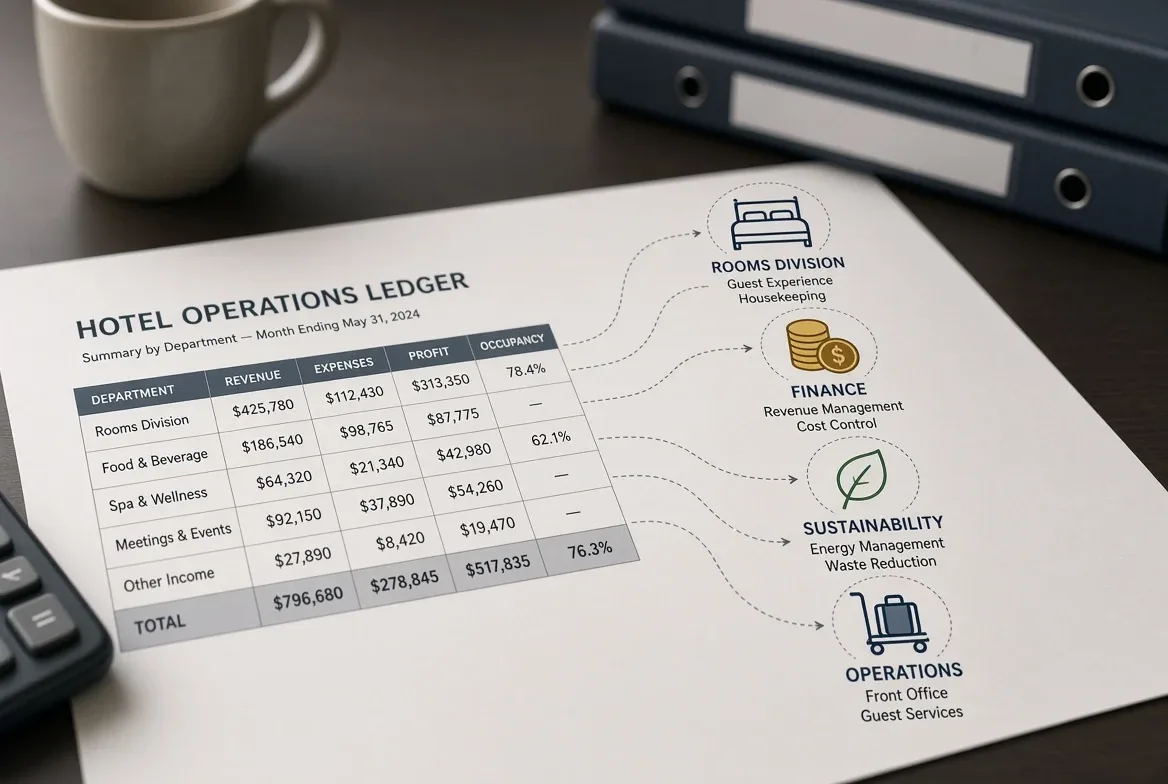
The 12th Revised Edition of the Uniform System of Accounts for the Lodging Industry (USALI) has been the required accounting standard for U.S. hotels that follow it since Jan. 1, 2026, according to HFTP, the nonprofit that owns and publishes the standard. The edition adds new payroll, distribution-channel and sustainability schedules that change what finance teams must track and report.
USALI is the accounting framework hotels use to standardize revenue and expense reporting across departments, so one property's numbers can be benchmarked against another's on a like-for-like basis. First published in 1926 by the Hotel Association of New York City, the standard has been owned and maintained by HFTP (Hospitality Financial and Technology Professionals) since the association transferred the copyright in 2018, according to USALI's official history page. HFTP says the 12th edition was developed with the HFTP/AHLA Global Finance Committee and is consistent with GAAP and IFRS.
For operators, the update is not cosmetic. Several of its new schedules touch line items finance chiefs and general managers already argue over: labor cost, distribution expense and sustainability spend.
What actually changed in the 12th edition?
The revision adds several new reporting schedules and reclassifies existing cost categories, according to HFTP's published FAQ on the edition. The changes span payroll, distribution, brand costs and utilities.
- Payroll FTE schedule. A new schedule reports staffing in full-time-equivalent terms by department.
- Annual Mandatory Brand and Operator Costs schedule. Franchise and management fees get a dedicated disclosure line rather than being folded into general costs.
- Rooms revenue by distribution channel. Bookings are now broken out into standardized categories such as brand direct, GDS and OTA.
- Energy, Water and Waste schedule. Utilities move out of general administrative costs into a dedicated schedule with consumption metrics, not just spend.
- All-inclusive property guidance. A new section applies to properties where package revenue exceeds 50% of total revenue, per the FAQ.
- Loyalty program and executive lounge accounting. Both get refined treatment under the new categories.
- Telecommunications costs move from Administrative and General into the Information and Telecommunications Systems department.
HFTP frames the goal as broader transparency: the FAQ states the revision aims to "enhance transparency in reporting and broaden data sets to better inform decision-making."
What does the new payroll schedule mean for labor reporting?
Under the prior edition, payroll was reported in dollar terms by department, with no standardized way to compare staffing levels across properties of different sizes. The new FTE schedule reports headcount in full-time-equivalent units alongside the payroll dollars, according to the FAQ.
That matters at the margin. A property that trims housekeeping payroll by cutting hours looks different in an FTE schedule than one that cuts payroll by eliminating positions outright — a distinction dollar-only reporting could not make. Owners and asset managers benchmarking labor efficiency across a portfolio now have a standardized figure to compare, rather than payroll dollars that shift with local wage rates and part-time mix.
How does distribution channel reporting change?
The 12th edition standardizes how rooms revenue is broken out by booking source — brand direct, global distribution system and online travel agency, among other categories — rather than leaving that breakdown to each hotel's own chart of accounts.
For a franchised property, that schedule sits next to the new Brand and Operator Costs disclosure. Together they make the cost of a booking — commission, GDS fee, brand fee — more visible against the revenue it produced. HFTP's materials do not put a dollar figure on any individual channel's cost; the schedules standardize how operators report the breakdown, not what any one property's numbers are.
Why add a sustainability schedule now?
The new Energy, Water and Waste schedule separates utilities from general administrative costs and asks properties to report consumption — kilowatt-hours, gallons, tons of waste — alongside the dollars spent, according to HFTP's FAQ on the edition. Previous editions tracked utility spend as a cost line; they did not standardize how consumption itself gets reported.
That distinction matters for operators facing sustainability disclosure requests from owners, lenders or corporate travel buyers: a consumption figure travels across a rate increase in a way a dollar figure does not. A property that cuts energy use but faces a higher utility rate would show flat or rising cost under the old schedule and falling consumption under the new one.
The edition also adds dedicated guidance for all-inclusive properties, defined in the FAQ as those where package revenue exceeds 50% of total revenue. Under prior editions, all-inclusive resorts had to adapt a schedule built around a la carte rooms and food-and-beverage reporting; the new section gives them a structure built for bundled pricing instead.
Who has to comply, and by when?
The 12th edition was published in July 2024, with a mandatory adoption date of Jan. 1, 2026, according to USALI's official history page — a deadline that has already passed as of this writing. HFTP's materials direct particular guidance to franchised properties and to all-inclusive operators above the 50% package-revenue threshold.
USALI compliance is not a matter of law; it is a voluntary industry standard that many owners, brands and management companies require through contract rather than regulation. HFTP's own materials describe the standard's purpose as supplying "hotel owners, managers and other interested parties" with comparable operating data, not as a legal filing requirement. Properties that never adopted USALI in the first place are not bound by the new edition at all; the schedules only bind operators and owners whose agreements already reference the standard.
For finance teams still reconciling old charts of accounts to the new schedules, the deadline has already passed; the work now is closing the gap, not deciding whether to start.
For a related hotels perspective, read A Note-Worthy Collaboration: W Hotels Teams Up with Viral Artist Thomas Lélu for Exclusive Accessories and Stationery.