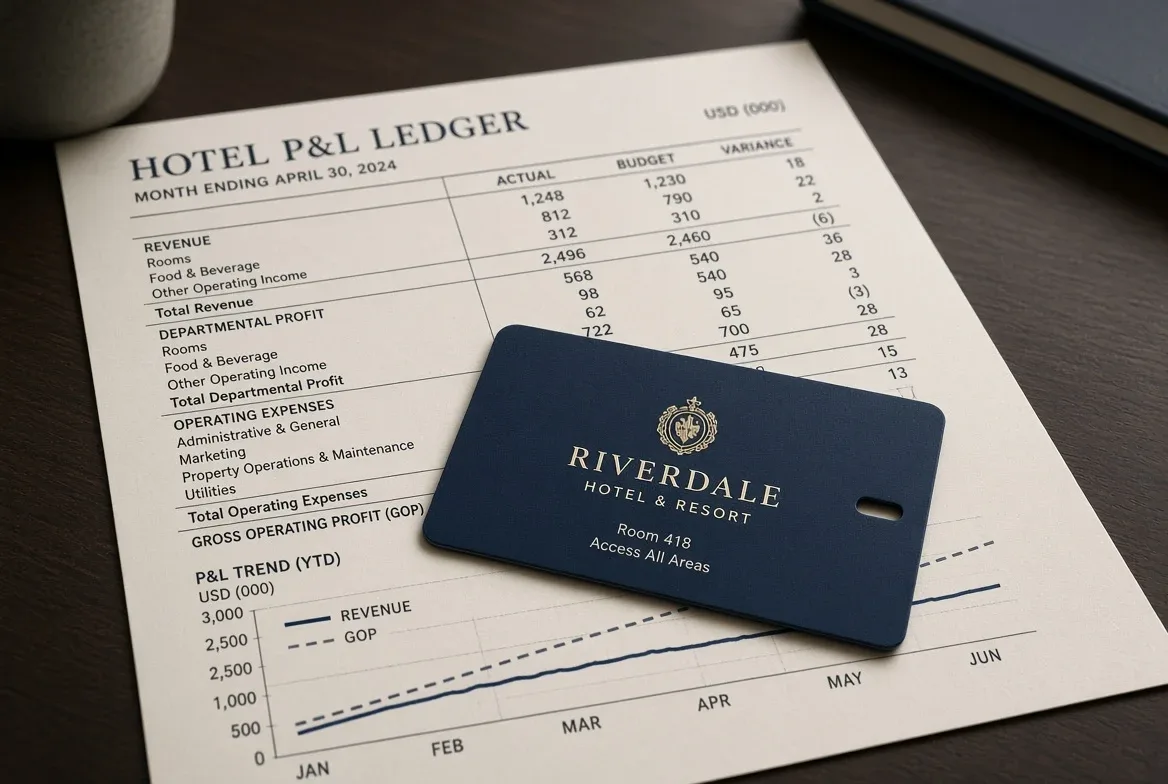
GOPPAR is gross operating profit per available room — the industry measure of how much profit a hotel produces from each room in its inventory, after operating expenses but before fixed charges such as rent, insurance and depreciation. For general managers and owners, it is the number that turns a strong RevPAR headline into an actual bottom line.
What is GOPPAR, and how is it calculated?
GOPPAR equals gross operating profit divided by the number of available rooms, according to CoStar's STR Benchmark glossary, the reference used across the industry for standard performance definitions.
Gross operating profit is total revenue across every hotel department — rooms, food and beverage, spa, parking, meeting space — minus the operating expenses management directly controls, before undistributed fixed costs and debt service are applied. CoStar describes GOPPAR as a measure of management's ability to generate sales while controlling the costs it has the most direct authority over, rather than a measure of top-line demand alone.
That distinction matters because a general manager has real influence over staffing levels, purchasing and departmental spend, but little or no influence over a property's rent, insurance premiums, mortgage terms or depreciation schedule. GOPPAR is built to isolate the part of the P&L a management team is actually judged on, which is why owners and asset managers use it alongside RevPAR rather than in place of it.
How does GOPPAR differ from RevPAR?
RevPAR tracks room revenue relative to available rooms and says nothing about cost. GOPPAR tracks profit across every revenue-generating department and every controllable operating expense, which is why the two numbers can move in opposite directions in the same reporting period.
| Metric | What it measures | Formula | What it leaves out |
|---|---|---|---|
| RevPAR | Room revenue performance | Room revenue ÷ rooms available | Non-room revenue and every operating cost |
| GOPPAR | Property-level operating profit | Gross operating profit ÷ rooms available | Fixed costs: rent, insurance, depreciation, debt service |
A property can post rising RevPAR while GOPPAR stalls or falls, if departmental costs — labor chief among them — are climbing faster than revenue. The reverse also happens: a property with flat RevPAR can grow GOPPAR by controlling departmental spend and capturing more non-room revenue, such as meeting space or food and beverage, without selling a single additional room-night at a higher rate.
That is why owners and asset managers read the two metrics together rather than treating either as a stand-in for the other. RevPAR answers a demand question — is the property filling and pricing its rooms well. GOPPAR answers a management question — is that demand being converted into profit once the property's own cost decisions are factored in.
Why do operators watch GOPPAR when RevPAR is rising?
Because a RevPAR gain does not guarantee a profit gain. STR data cited by Hotel Dive showed national GOPPAR at $77.37 in February 2023, up 1.6% from the prior month and the highest level since October 2022 — but total labor cost per available room ran $73.70, up 2.9% over the same span, and STR's financial performance director, Raquel Ortiz, said profit margins remained "just one percentage point below 2019."
For operators, that gap between a revenue recovery and a margin recovery is the entire point of tracking GOPPAR separately. A property manager reading only RevPAR in early 2023 would have seen a recovering top line; a property manager reading GOPPAR alongside it would have seen how much of that recovery labor costs were still absorbing.
What does market-level GOPPAR data show?
National GOPPAR rose 3.7% year over year in October 2023, according to CoStar data reported by Hotel Dive, with New York City leading all U.S. markets at nearly 60% growth for the month. Across the top 25 U.S. markets, GOPPAR was up 11% year to date through October 2023, even as labor costs in those markets climbed 14% over the same period.
Eight of those 25 markets posted double-digit GOPPAR growth, which CoStar's reporting tied to a recovery in weekday group and corporate demand strong enough to outrun rising labor costs — a pattern visible in food and beverage departmental costs per occupied room, which grew faster than any other department that year.
What is the RevPAR and GOPPAR outlook into 2026?
CoStar and Tourism Economics forecast, in a report published January 28, 2026 and covered by Hotel Dive, that U.S. RevPAR will grow just 0.6% year over year in 2026, with ADR up 1% and occupancy easing slightly to 62.1%. The firms project RevPAR growth accelerating to 1.4% in 2027.
For operators, the math changes at the margin. When revenue-side growth is forecast near flat, GOPPAR becomes the lever management can still pull — through labor scheduling, departmental cost control and procurement — because the room-revenue side of the ledger is not expected to do much of the work on its own.
How do operators actually move GOPPAR?
GOPPAR responds to the departmental cost decisions a property makes every week, not just to room rates. The levers operators use most, based on the cost categories that show up in the data above, are largely staffing and procurement rather than pricing.
- Labor scheduling against forecast demand, rather than fixed staffing patterns, since labor is consistently the largest controllable cost line in the figures above.
- Departmental cost discipline in food and beverage, the department that showed the fastest year-to-date cost growth in the October 2023 data reported by Hotel Dive.
- Procurement and vendor terms across housekeeping supplies, F&B inputs and maintenance contracts, which sit inside gross operating profit and therefore inside GOPPAR.
- Non-room revenue capture — banquet, meeting space, parking and ancillary fees — which adds to gross operating profit without adding an available room to divide it by.
None of those levers require a rate increase. That is the operational case for tracking GOPPAR alongside RevPAR: it shows whether a property is converting demand into profit, not only into revenue.
For asset managers comparing properties across a portfolio, GOPPAR also travels better than raw profit dollars, since it normalizes for the number of rooms a property has to sell. A 400-room convention hotel and a 90-room boutique property cannot be compared on total gross operating profit alone; dividing by available rooms puts them on the same footing.
For a related hotels perspective, read "In Freedom We Trust" - Trust Wallet Empowers Users To Take Control Of Their Financial Future With Latest Brand Film.